Obsessive-Compulsive Disorder (OCD) is possibly one of the most misunderstood mental health diagnoses, despite a staggering 8.2 million adults in the United States living with OCD, as of 2024. The term is often used casually in everyday conversation, which can unintentionally minimize the very real distress that people with OCD experience.
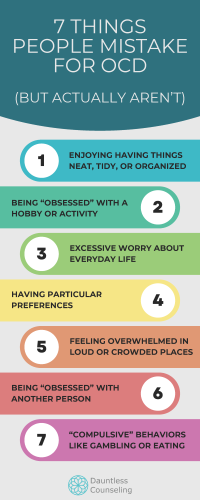
With this in mind, I wanted to share seven situations that are often mistaken for OCD, but actually describe something different.
Table of Contents

1. Enjoying having things neat, tidy, or organized
Many people enjoy organizing their homes, keeping their desks clean, or arranging things in a visually pleasing way. Individuals who like structure or cleanliness sometimes jokingly say, “I’m so OCD.”
However, liking order is not the same thing as OCD. In OCD, organization or cleaning behaviors are typically driven by intense anxiety or intrusive thoughts. The person may feel that something bad could happen if things are not arranged “correctly,” or they may feel unable to stop the behavior even when they want to.
2. Being “obsessed” with a hobby or activity
People often say they’re “obsessed” with something they enjoy, like a new TV show, exercise routine, or hobby. While someone might spend a lot of time thinking about or engaging in these activities, the experience is usually enjoyable and voluntary.
OCD obsessions, on the other hand, are unwanted, intrusive thoughts or urges that cause distress. Rather than being pleasurable, they are typically upsetting, frightening, or deeply uncomfortable.
3. Excessive Worry about Everyday Life
Some people experience persistent worry about things like work, finances, family health, or the future. When this worry becomes excessive and difficult to control, it may be related to Generalized Anxiety Disorder (GAD), rather than OCD.
While both conditions involve anxiety, GAD centers on ongoing worry about real-life concerns, whereas OCD involves intrusive thoughts and ritualistic behaviors aimed at reducing anxiety.
4. Having Particular Preferences
Many people have personal preferences—maybe you don’t like your food touching on your plate, or you prefer sitting in a certain spot on the couch. These are examples of quirks or habits, not OCD.
With OCD, the behavior is typically not just a preference. The person may feel a powerful urge or anxiety that drives them to repeat certain behaviors or follow rigid rules, often to prevent a feared outcome.
5. Feeling overwhelmed in loud or crowded environments
Some individuals are more sensitive to sensory input than others and may feel uncomfortable in noisy, chaotic, or crowded spaces. This can be related to sensory sensitivity, anxiety, or other conditions.
While people with OCD can also feel overwhelmed, sensory sensitivity itself is not OCD. OCD specifically involves intrusive thoughts and repetitive behaviors meant to relieve distress.
6. Being “obsessed” with another person
In everyday language, people sometimes say someone is “obsessed” with another person. In more serious situations, this could involve stalking behaviors or conditions such as erotomania, where someone believes another person is secretly in love with them.
Although the word “obsession” is used here, this does not refer to OCD obsessions, which are intrusive thoughts within a person’s own mind rather than fixations on pursuing another individual.
7. “Compulsive” behaviors like gambling, eating, or sex
The word “compulsive” is often used to describe behaviors such as compulsive gambling, overeating, or sexual behaviors. These can be associated with impulse control disorders or behavioral addictions.
In OCD, compulsions are specific repetitive behaviors or mental rituals performed to reduce anxiety caused by an obsession. They are not done for pleasure or reward, but rather to temporarily relieve distress.
So what is OCD, actually?
Obsessive-Compulsive Disorder (OCD) is a mental health condition consisting of two key components: obsessions and compulsions.
Obsessions are intrusive, unwanted thoughts, images, or urges that repeatedly enter a person’s mind and cause significant anxiety or distress. These thoughts are often disturbing or inconsistent with the person’s values, and they can be very difficult to ignore or dismiss.
Compulsions are repetitive behaviors or mental actions that a person feels driven to perform in response to an obsession. These behaviors are typically done in an attempt to reduce anxiety or prevent a feared outcome, even if the connection between the action and the feared event is not logical.
Common examples might include excessive checking, repeated handwashing, mental counting, reassurance seeking, or repeating certain actions until they feel “just right.” Someone with OCD might spend hours at work mentally reviewing if they turned the stove off at home, even after repeatedly confirming that it was off before they left.
For people with OCD, this cycle of obsessions and compulsions can become time-consuming, exhausting, and highly disruptive to daily life.
When to Consider Talking to a Therapist
If intrusive thoughts or repetitive behaviors are taking up significant time, causing distress, or interfering with daily life, it may be helpful to speak with a mental health professional.
If you’re curious to learn more about what OCD actually is—including common types, symptoms, and treatment options—feel free to check out my article dedicated entirely to understanding OCD.
As a reminder, this blog post is not intended as professional counseling or clinical advice. This article is meant to provide you with some helpful information about what OCD is not. If you are struggling with your mental health, I encourage you to consider reaching out for additional support, professional or otherwise.

– Kristel Roper, LMFT, LPCC
Kristel Roper is a licensed psychotherapist offering therapy services to individuals in the Sacramento area. She specializes in therapy for anxiety and OCD and especially enjoys supporting women, children, and parents of anxious kiddos. If you have a question for Kristel or are interested in therapy for yourself or your loved one, feel free to reach out.
Photo by Tobias Bjørkli from Pexels